
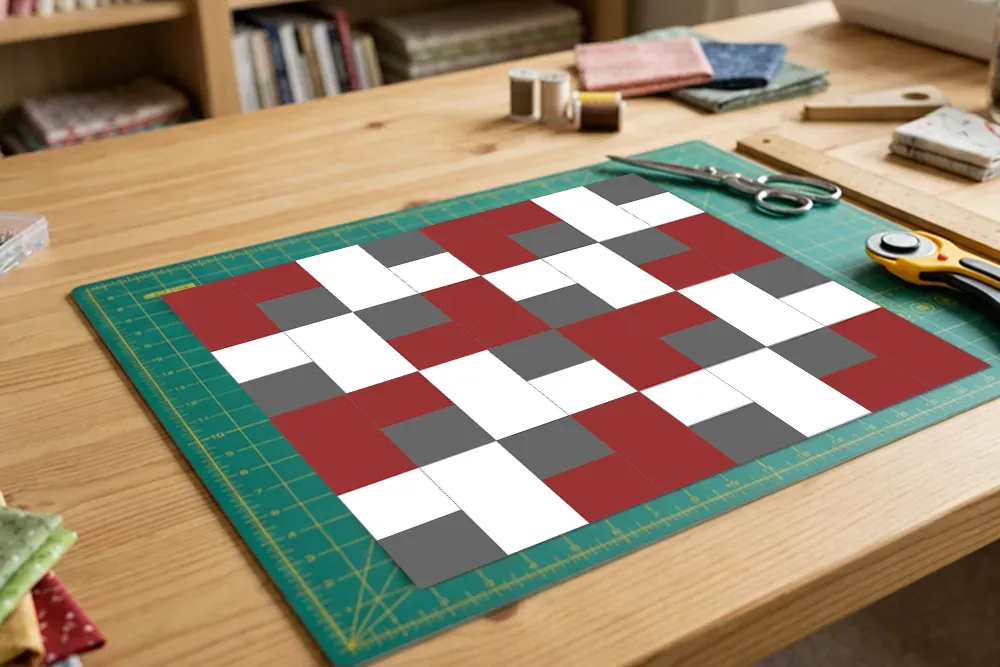
If you’re looking for a first block that builds real skills without overwhelming you, let me introduce you to one of my favorites: the Turtle Block. It’s simple to make, endlessly versatile, and so satisfying to watch come together — exactly the kind of block I love putting in a new quilter’s hands.
Why I love the Turtle Block
A few reasons this little block earns a permanent spot in my teaching rotation:
It’s all straight seams.
No triangles, no curves, no bias edges to stretch out of shape. The Turtle Block is built entirely from squares and rectangles, which makes it wonderfully approachable — you can focus on your piecing without wrestling with tricky angles.
It uses just three fabrics.
A dark, a medium, and a light — that’s it. Three fabrics keep your fabric pull simple and let the “placement” do the heavy lifting (more on that in a moment).
It’s full of movement.
Despite being made of nothing but squares and rectangles, the Turtle Block has a lovely diagonal flow that travels right across it. It looks far more intricate than it actually is — which, if you’ve been around the studio for a while, you know is my very favorite kind of design.
It’s a wonderful skill-builder.
This block is a perfect place to practice two habits that pay off in every quilt you’ll ever make: nesting your seams so your rows lock together neatly, and matching your points for crisp, accurate intersections. Practice them here, on a small and forgiving block, and you’ll carry that confidence into everything that comes next.
A Look at How It’s Built
The Turtle Block is a four-patch — a simple 2 x 2 grid — made from five straightforward components:
(2) red rectangles
(2) red squares
(4) gray squares
(2) white rectangles
(2) white squares
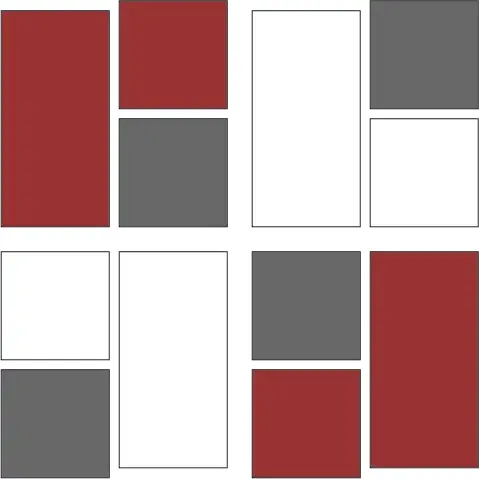
Each quarter of the block is its own little unit, and once you’ve made four of them, you arrange them into that 2 x 2 grid. Because it’s straight-seam piecing all the way through, the whole block comes together quickly — and it’s a joy to chain piece if you’re making more than one.
Make it Your Own
Here’s where the Turtle Block really shines. Because it’s asymmetrical, it transforms dramatically depending on two things: where you place your light, medium, and dark fabrics, and how you rotate the blocks.
A few of the many looks you can create by changing fabric placement and block rotation.

Swap which fabric sits where, and the whole personality of the block changes. Rotate your blocks as you set them together, and secondary patterns begin to appear across the quilt. It’s the same handful of pieces every time — but the design possibilities are genuinely endless. Grab some scraps and just play before you commit to a layout; you’ll be surprised what you discover.
Ready to Make One?
I’ve put together a free Turtle Block pattern with everything you need to make your own — including a cutting chart for three finished sizes (6″, 9″, and 12″) and clear, step-by-step assembly instructions with illustrations.
Download the free Turtle Block pattern >>
Whether you make a single block to practice your piecing or a whole stack to play with layouts, the Turtle Block is a friendly, rewarding place to grow your skills. I can’t wait to see what you make — and remember, there’s no wrong way to make it your own.
Until next time, happy quilting!